Minesweeper patterns: the 1-2-1, the 1-1 and the tricks that solve most boards
· 3 min read
Stop counting square by square. The handful of patterns experienced players spot instantly, how chording works, and how to beat the daily board.
Minesweeper looks like a game of luck the first time you play it. It isn't, especially on a no-guess board: every square can be worked out. What separates a slow solve from a fast one is pattern recognition, so here are the patterns worth learning, roughly in the order you'll meet them.
First, the two basic rules
Everything else is built on these:
- A number already touching all its mines: every other square around it is safe. A 1 with one flag next to it means its other neighbours are clear.
- A number with exactly as many hidden squares as mines: they're all mines. A 2 touching only two unopened squares has a mine in each.
The 1-1 against a wall
When two 1s sit side by side along an edge (the wall of the board, or a line of opened squares), the mine for the first 1 has to be in the two squares it shares with the second. So the square beyond the second 1, on the far side, is safe. It's the pattern you'll use most.
The 1-2-1
Three numbers in a row along a flat edge reading 1, 2, 1: the mines are under the two 1s, and the square under the 2 is safe. It looks backwards the first time, but the 2 needs two mines and the 1s can only have one each.
The 1-2-2-1
Four in a row along a flat edge reading 1, 2, 2, 1: the mines are under the two 2s, and the squares under the 1s are safe.
When you're stuck, look for the difference between two neighbouring numbers. If a 3 and a 2 share most of their squares, the extra mine has to be in the squares only the 3 can see.
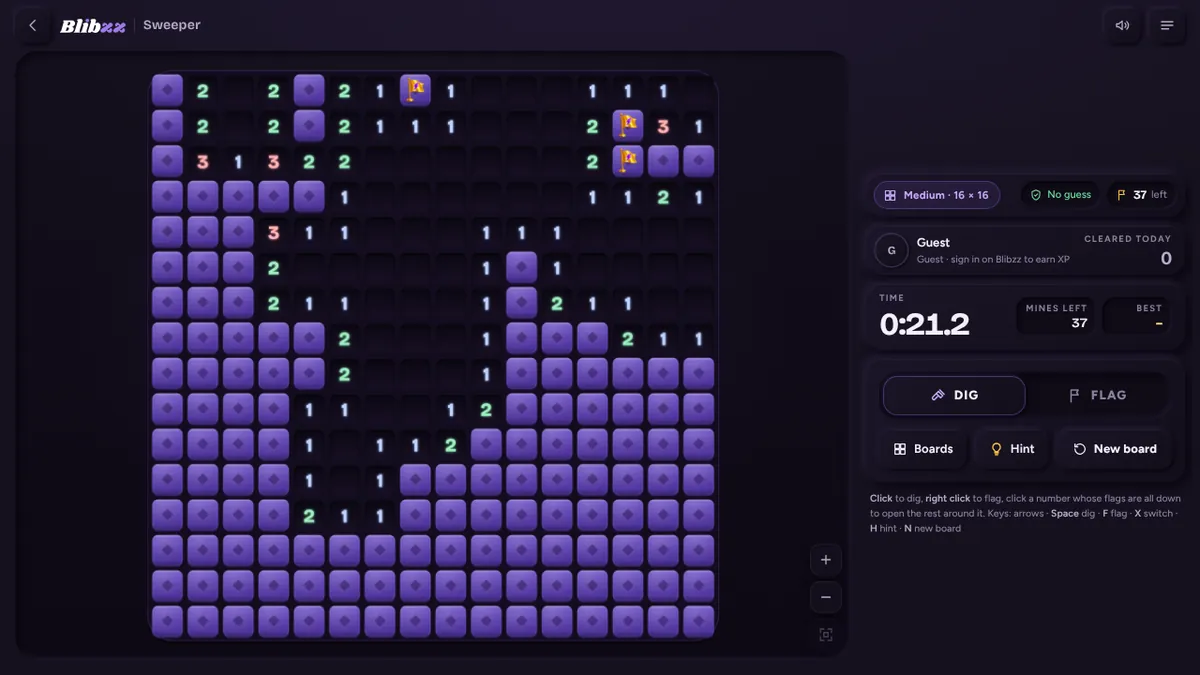
Chording: the biggest speed-up there is
Once a number has all its mines flagged, tap the number itself and every other square around it opens at once. On Blibzz Sweeper you can tap a number whose flags are all down. Learn it on Easy; it turns Expert from a slog into a flow.
Board sizes and how hard they really are
| Level | Board | Mines | Share of squares that are mines |
|---|---|---|---|
| Easy | 9 × 9 | 10 | 12% |
| Medium | 16 × 16 | 40 | 16% |
| Expert | 30 × 16 | 99 | 21% |
Expert is harder for two reasons: more squares, and more mines per square, which means fewer free openings and more patterns to read.
No-guess boards
Classic Minesweeper sometimes leaves you a genuine 50/50 at the end. On Blibzz Sweeper, no-guess boards (on by default) are checked by our server before you see them: every square can be deduced from your first dig. If you're stuck, there is always a safe move somewhere. That's oddly reassuring, and it makes races against a friend fair.
The daily board
One board a day, the same for everyone, and only your first try counts for the day's fastest times. The best approach is the boring one: slow and right beats fast and wrong. Flag only what you're certain of, because a wrong flag breaks chording.
Blibzz Sweeper: rules, odds and tips · Play Blibzz Sweeper free